WorldView as a Compatibility Factor
WorldView Is Important
WorldView is a paradoxical compatibility factor because, although it can be observed through behavior—such as ambition, conflict resolution, or service orientation—it is ultimately an internal and perceptual concept. While it may appear to define how people act, it more accurately reveals how individuals see, interpret, and assign meaning to the world. This means that two individuals might exhibit similar behaviors yet be operating from fundamentally different stages of consciousness.
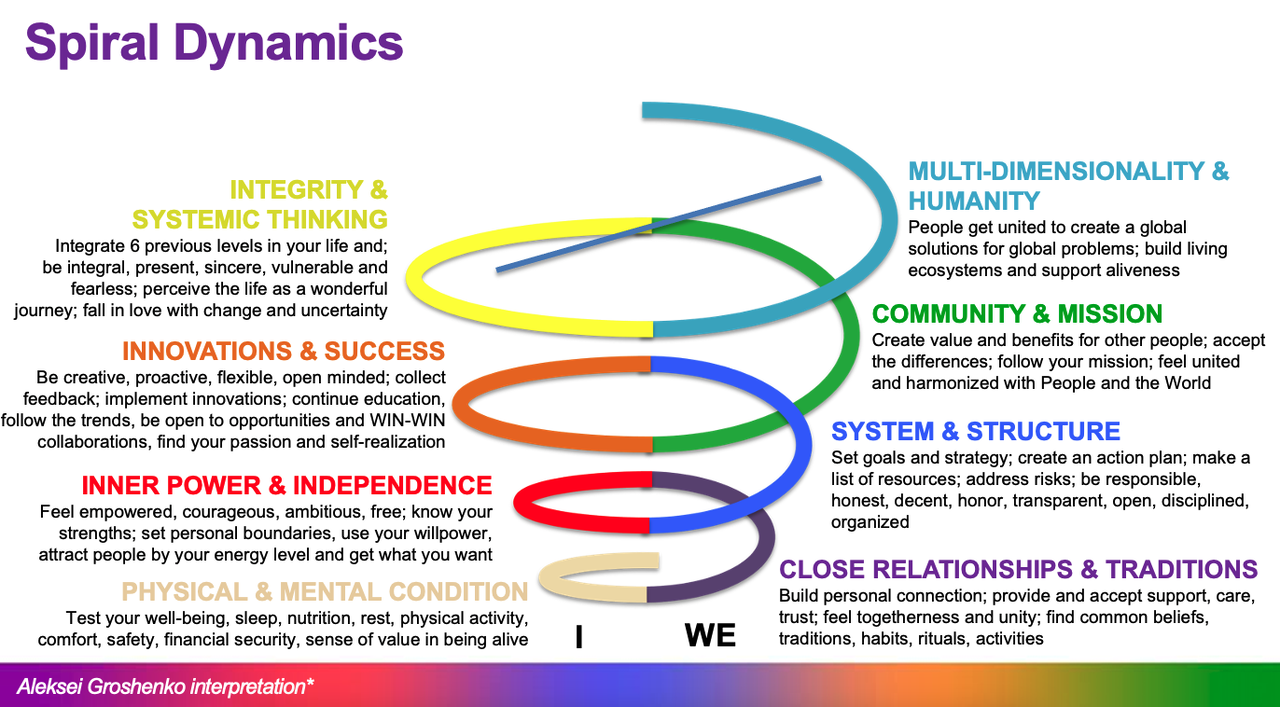
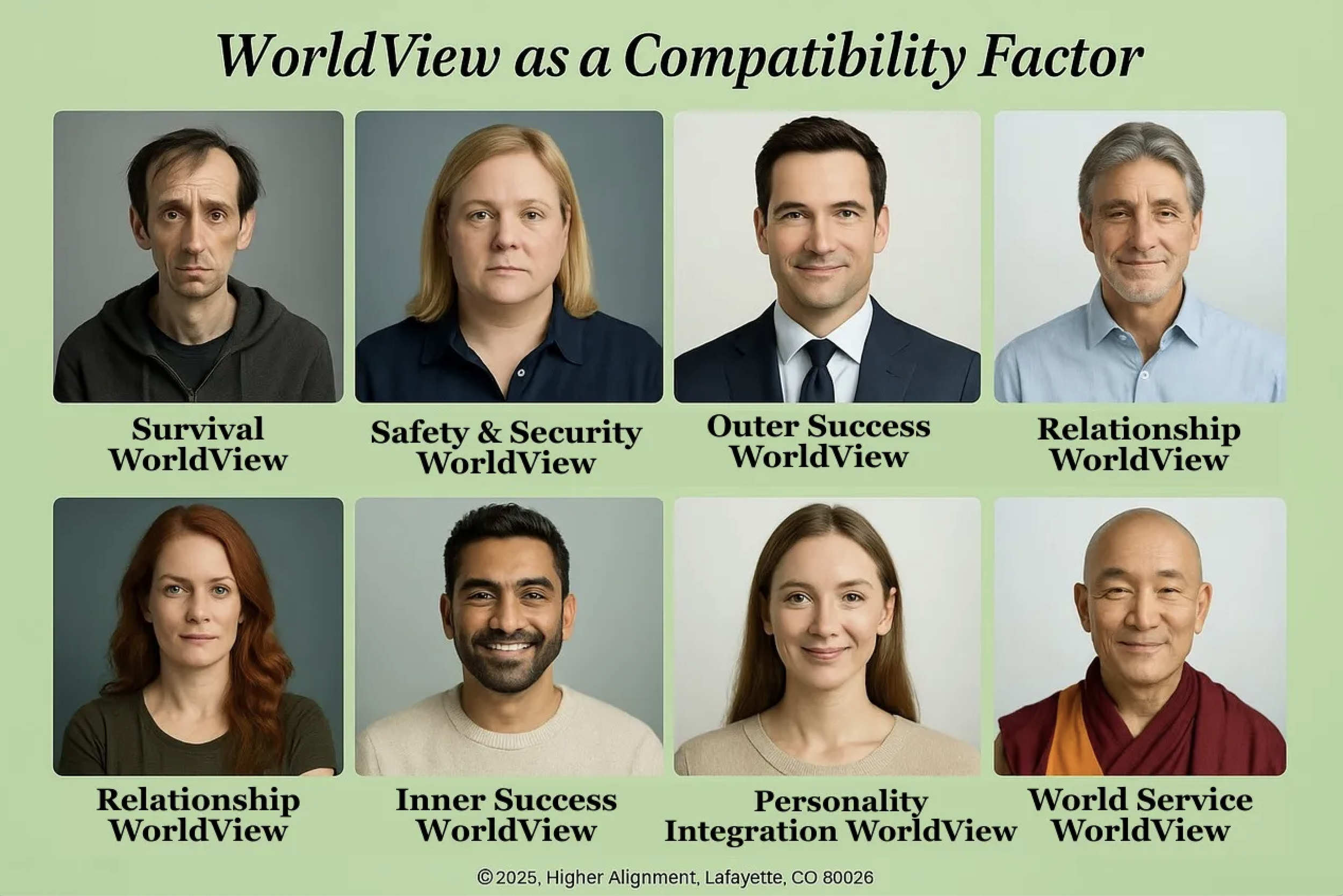
WorldView is not a hierarchy of status, but a developmental spectrum of consciousness. We all begin with a pre-personal focus—concerned with Survival, Safety, and Security. As we grow, we enter the personal stages of Outer Success and Relationships. Later, through inner work, we step into transpersonal orientations, such as Inner Success and Personality Integration. Finally, in the impersonal domain of World Service, we transcend self-importance entirely and become vessels of collective wisdom.
The common confusion is mistaking these stages as measures of worthiness or intelligence. Unconscious individuals tend to view WorldView hierarchically: higher levels are “better” and more powerful. In contrast, conscious individuals recognize WorldView as a responsibility—a call to simplify their insights so others can join them. They understand that their developmental advantage is not something to assert but to translate and model in relational ways.
In essence, WorldView teaches us how to learn together. When two people operate at different levels, the more conscious individual must listen more deeply, honor the learning process, and offer grounded leadership without imposing. This is especially critical beyond Relationship WorldView (Level 4), where collective purpose and mutuality become essential for collaboration. The goal is not superiority, but shared learning and creative emergence.
The Value of Using WorldView in Making Relationship Choices
(And the Cost of Not Doing So)
When we make relationship choices without understanding WorldView, we often mistake surface compatibility for deep resonance. We fall in love with someone’s charm, their accomplishments, their emotional availability—or even their vision of the future. But what we don’t see is how they fundamentally interpret life. And this misalignment in interpretation, if unaddressed, becomes the quiet fracture that eventually splits partnerships apart.
WorldView is the invisible architecture behind our choices, our growth patterns, and the meaning we assign to love.
It is not just what we value, but how we assign value in the first place.
Why WorldView Matters in Relationship Choice
Every individual operates from a dominant stage of WorldView—a developmental lens through which they interpret safety, success, connection, purpose, and love. The closer two individuals are in their current WorldView, the easier it is for them to speak a shared language of meaning. They navigate challenges with mutual trust, grow in similar ways, and interpret the “why” of the relationship through compatible frames.
For example:
Someone operating from Outer Success WorldView (Stage 3) may want a partner to build a life with—focusing on tangible goals and measurable progress.
Someone in Relationship WorldView (Stage 4) is focused on emotional presence and vulnerability—wanting to be felt, not just supported.
Someone in Inner Success WorldView (Stage 5) is learning to define life and love on their own terms—often wanting freedom, alignment, and inner truth more than partnership as a role.
When partners operate at different levels without awareness, friction is inevitable. One may feel unseen, the other misunderstood. One wants security, the other wants presence. One wants answers, the other wants the question to deepen.
The Cost of Ignoring WorldView in Relationships
Without the conscious use of WorldView:
We overcommit based on physical chemistry and idealization, not on shared developmental values.
We confuse effort with alignment—working harder to “fix” what was never structurally compatible.
We often fault our partners for not seeing things the way we do, rather than understanding how they naturally frame their experience.
We project our expectations and feel betrayed when they are not met—not realizing we never agreed on the kind of growth we were seeking.
We may stagnate, fearing to outgrow or be outgrown, when in truth we’re just seeing from different levels of depth.
In short, we mistake difference in WorldView for incompatibility of love. Or worse—we try to drag someone forward, or hold ourselves back, to preserve a relationship that cannot breathe.
The Benefit of Choosing Relationships Through WorldView Alignment
When we consciously factor in WorldView, we choose relationships not just for who someone is—but for where they are in their journey. We learn to:
Honor difference without domination.
Spot potential for mutual evolution.
Trust that alignment in how we grow is more essential than agreement in what we like.
Lead without ego, follow without fear.
Create containers of mutual respect where we can deepen—not diminish—our path of becoming.
WorldView brings compassion to difference. It replaces blame with curiosity. It turns conflict into curriculum.
The greatest value of using WorldView in relationship choice is that it helps us right-size our expectations—and root our commitments in shared development, not fantasy.
The Seven Stages of WorldView
Each WorldView stage represents a qualitative expansion in perception, responsibility, and creative response. These stages unfold progressively as we master more subtle lessons and embody increasing inner authority. Each stage generates a new continuum of development and is marked by a guiding question, a developmental lesson, and the acquisition of new capacities.
1. Survival WorldView
(Pre-personal: Birth–Age 3)
Guiding Question: Am I safe enough to exist?
Lesson: Physical self-preservation, instinctual fear regulation.
Key Experiences: Hunger, threat, comfort, sensory attachment.
Creative Power: Raw life energy.
Practices: Self-soothing, embodied awareness, rhythmic stability.
This stage is driven by the need to survive and meet basic needs. Creativity shows up as the body’s response to stimulation and the intuitive navigation of danger and nurturing.
2. Safety & Security WorldView
(Pre-personal: Ages 3–7)
Guiding Question: Who will protect and care for me?
Lesson: Seeking structure, attachment, and control of basic needs.
Key Experiences: Parental bonding, boundary formation, dependency.
Creative Power: Reactive desire for consistency.
Practices: Trust building, learning routines, protection modeling.
Here, children begin to see cause and effect in their environment. They seek a sense of belonging through routines and familiarity. When distorted, this becomes a lifetime pattern of seeking approval or creating walls to avoid vulnerability. Some never move beyond this stage.
3. Outer Success WorldView
(Personal: Ages 7–21+)
Guiding Question: How do I demonstrate my value and capabilities?
Lesson: Identity construction, social recognition, ambition.
Key Experiences: School success, peer validation, performance.
Creative Power: Focused striving.
Practices: Competence building, goal setting, authority challenge.
This is the world of resumes and roles. Individuals define themselves by external accomplishments. The shadow here is burnout or emptiness when success doesn’t lead to self-worth. Many never leave this level of WorldView.
4. Relationship WorldView
(Personal: Young Adult to Midlife)
Guiding Question: Can I be known and loved for who I am?
Lesson: Mutual vulnerability, intimacy, emotional truth.
Key Experiences: Romantic partnerships, emotional conflict, co-dependence.
Creative Power: Emotional connection.
Practices: Self-disclosure, boundary negotiation, feeling expression.
Relationship WorldView becomes the bridge to transpersonal awareness. Without healing previous wounds of safety, success, and intimacy, we become stuck in idealization or dependency here. Many lose momentum before reaching Relationship, level 4, but if we pass this level, we slowly continue growing.
5. Inner Success WorldView
(Transpersonal)
Guiding Question: What is true for me, regardless of others?
Lesson: Inner knowing, authenticity, intrinsic value.
Key Experiences: Awakening, solitude, personal rituals, divergence.
Creative Power: Wisdom.
Practices: Meditation, creative solitude, intuitive exploration.
Here, the approval of others fades, replaced by trust in one’s own inner compass. Relationships shift from seeking to sharing. Distinctions between performance and purpose dissolve.
6. Personality Integration WorldView
(Transpersonal)
Guiding Question: Can I love all parts of myself as a unified whole?
Lesson: Integration of shadow and light, acceptance of paradox.
Key Experiences: Ego death, trauma healing, radical self-love.
Creative Power: Alchemical synthesis.
Practices: Shadow work, forgiveness, inner harmonization.
This stage reconciles fragmented identities and conflicting drives. We no longer need to choose between truth and goodness or sacrifice joy for service. We operate from internal unity.
7. World Service WorldView
(Impersonal)
Guiding Question: How can I be of service without self-reference?
Lesson: Surrender, stewardship, radiant love.
Key Experiences: Collective visioning, global empathy, Co-Creative emergence.
Creative Power: Impersonal love in action.
Practices: Mentoring, transpersonal leadership, standing in possibility.
World Service is not about doing more but being more present. It’s grounded in humility and trust that every step is part of a greater unfolding. Our being becomes the offering.
Case Study: Juan and Anita -
Learning to Trust Through the Mystery of Relationship
(Relationship WorldView Level 5)
Juan and Anita are both committed, passionate individuals who’ve spent much of their lives seeking connection, meaning, and alignment. At first glance, they seem like a great match—both deeply relational, open-hearted, and eager to build something meaningful. But under the surface, they are wrestling with very different expectations rooted in their WorldView development and cultural background.
The Setup
Juan grew up in a Latin American family steeped in tradition, structure, and defined roles. His upbringing taught him that love meant commitment, clarity, and action. His father planned everything—from family vacations to business investments—and his mother praised follow-through and discipline. As a result, Juan developed a strong internal belief: “If you don’t know where you’re going, how will you ever get there?”
Anita was raised in a Pacific Northwest countercultural community, where fluidity, presence, and emotional sovereignty were prized. Her parents taught her that true love was an unfolding, a mystery not to be contained or controlled. They modeled a sense of relational presence that emphasized intuition and non-attachment. To Anita, trying to define love through rigid plans is what kills it.
Now in their early thirties, Juan and Anita are deeply in love—but struggling to bridge their internalized orientations to trust. Both are operating within Level 5 of Relationship WorldView, but they express it in radically different ways.
The Conflict
Juan wants to talk about the future. Not in a controlling way—but as an expression of care. He sees planning as a form of love. “What are our next steps? Should we move in together in six months? Should we think about savings, or how we’d raise kids?”
Anita hears these questions as a premature attempt to lock in outcomes. Her response is consistently gentle but mysterious:
“Why do we need to name it right now? Can’t we just be in it? I feel like what’s possible between us is bigger than anything we can plan. If we try to control it, we might miss what’s trying to happen.”
Juan feels destabilized. Her answers seem vague, noncommittal, and even evasive.
“But what does that mean?” he asks. “How do I know we’re moving forward if there’s no direction?”
Anita doesn’t want to be pinned down. She feels most open when things are uncertain. “Plans don’t make me feel safe,” she says. “They make me feel boxed in. I want to build a life together, but not one we’ve overdesigned. I want to feel it into being.”
At the heart of their conflict is a deeper philosophical tension:
Juan seeks security through structure. Anita seeks possibility through surrender.
Both are sincere. Neither is wrong. But without translation, their love begins to feel misaligned.
The Opportunity
What Juan doesn’t yet fully grasp is that Anita is committed—but her commitment is to the process, not the plan. Her worldview has taught her that the most authentic relationships emerge when we trust the unfolding. She isn’t avoiding intimacy—she’s offering a deeper kind.
What Anita doesn’t yet see is that Juan’s desire for clarity isn’t about control—it’s about being able to show up fully. He wants to invest, and he believes that investment requires some shared orientation. Without it, he feels like he’s giving into a void.
The WorldView Interaction at Play
At Level 5: Relationship WorldView, we move from transactional belonging (you give me this, I give you that) to mutual transparency. We begin asking:
“Can I be fully seen, held, and loved—without fixing or being fixed?”
This level requires navigating ambiguity. It demands that we learn how to co-measure each other’s truths without collapsing into hierarchy or fear. The feminine path at this level emphasizes presence, mystery, and the process of becoming. The masculine path emphasizes direction, focus, and honoring what is emerging through form.
Juan and Anita are learning to meet across that polarity.
The Practice of Co-Measurement
For Juan, the practice is to pause his instinct to nail things down. To listen not only to Anita’s words but the energy behind them. Her trust may not sound logical, but it feels steady. Her embodied calm, her daily devotion, and her attunement to what’s happening between them are her roadmap.
For Anita, the practice is to speak a little more plainly. Not to surrender her mystery, but to help Juan feel her commitment in a language he can metabolize. She doesn’t need to produce a five-year plan—but she might name what she’s building her life around: connection, Co-Creation, and presence.
Together, they can evolve their relational field if they learn to trust that they’re speaking the same truth in different dialects.
A Shared Vision Beyond the Conflict
Anita might offer: “What if our future is something we invite, not design? What if the clarity you seek comes from how we feel over time, not a plan we impose?”
Juan might reply: “What if we make one agreement—not about what we do, but how we’ll stay connected? Could we agree to check in monthly, to make sure we’re both still choosing this?”
Now they are co-measuring—offering each other translation bridges into deeper trust.
Reflection
Juan and Anita’s journey is not just about navigating personal differences. It’s about embodying Level 5 Relationship WorldView:
releasing ego-driven agendas
learning to tolerate ambiguity
trusting that love can grow without a script
Together, they are discovering that true partnership isn’t about shared control—it’s about shared presence. The future, as Anita says, might be better than we can imagine. But only if we let it come to us—through mutual surrender and aligned trust.
Final Reflection: Learning the Seven Lessons Together
Each WorldView offers a gateway to a core lesson: survival, safety, success, connection, authenticity, integration, or service. These are not just personal milestones, but shared thresholds.
When we engage in conscious relationships, we learn these lessons together more easily. Why? Because mutual vulnerability, responsiveness, and co-measurement allow us to test and reinforce new consciousness with someone else.
The most important lesson is always the one you’re learning now. And if you’re in partnership, the lesson will reveal itself as a shared growth edge—an invitation to deepen your capacity to see and be seen, hold and be held, teach and be transformed.
Let us walk these stages, not to “arrive” but to learn how to move together with grace.
Larry,
Founder, Higher Alignment